Understanding the Roots of Jazz: From New Orleans to Bebop
The story of jazz begins in the vibrant port city of New Orleans at the turn of the twentieth century. There, a confluence of musical traditions—African rhythms, blues, ragtime, brass band marches, and European classical harmonies—created a fertile ground for a new form of expression. Early jazz was not a single style but a living, evolving conversation among musicians who improvised within loose frameworks, often drawing on collective memory and personal emotion. This article examines the key stages in the development of jazz, from its roots in the streets and dance halls of New Orleans through the revolutionary changes of the bebop era, and considers how these transformations resonate in contemporary music.
Understanding the roots of jazz requires looking at both the social and musical environments that shaped it. The city’s diverse population, its role as a cultural crossroads, and the legacy of Congo Square—where enslaved Africans gathered to play music and dance—provided the raw materials. As musicians began to formalize their sounds in the early 1900s, they created a music that was both deeply personal and communal. The journey from New Orleans to bebop is not a linear progression but a series of stylistic shifts, each responding to internal artistic pressures and external social changes.
Melodic Insight recognizes that exploring these historical layers helps listeners appreciate the depth and complexity of jazz. By tracing the evolution of its forms, improvisational language, and cultural context, we can see how jazz continues to inform modern genres while remaining a vibrant, evolving tradition in its own right.
The Birthplace: New Orleans and Early Jazz Styles
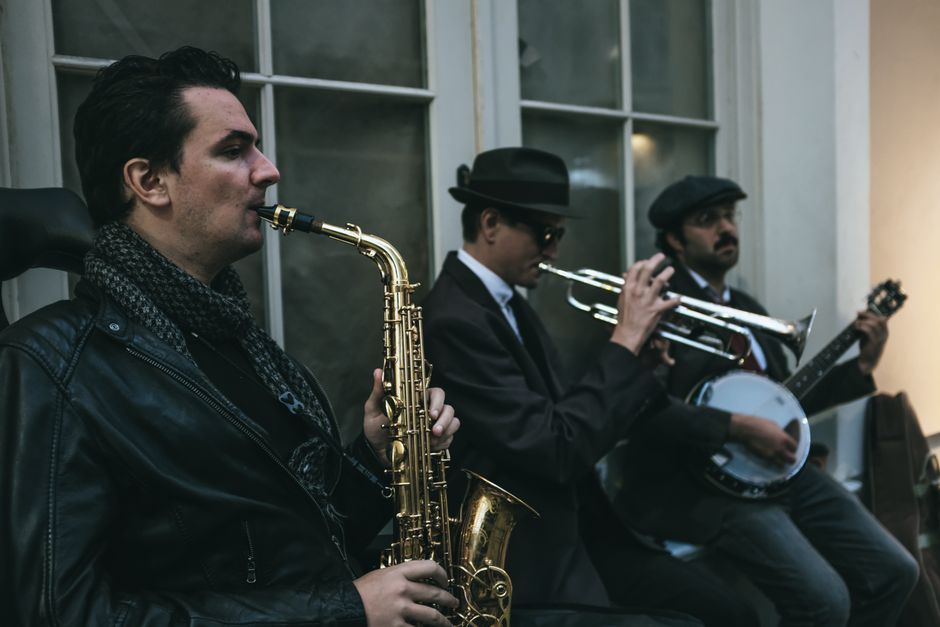
New Orleans in the early 1900s was a city where music was woven into daily life. Funeral processions led by brass bands, street parades, and dance halls provided constant opportunities for musicians to perform and experiment. The early jazz ensemble typically included cornet, clarinet, trombone, piano, banjo, drums, and sometimes a tuba or bass. These instruments blended polyphonic textures, with each player contributing a distinct melodic line while maintaining a collective rhythmic drive.
Key figures such as Buddy Bolden, Jelly Roll Morton, and Sidney Bechet helped define the early sound. Bolden, though never recorded, is remembered for his powerful cornet playing and ability to draw crowds. Morton, a pianist and composer, claimed to have invented jazz, and his compositions like “King Porter Stomp” bridged ragtime and jazz. Bechet’s virtuosic clarinet and soprano saxophone playing introduced a more lyrical, personal approach. The music was characterized by syncopated rhythms, blues inflections, and a strong sense of swing that invited listeners to dance.
Improvisation in early jazz was often collective, with musicians weaving around a basic melody. The process of improvisation relied on a shared vocabulary of riffs, licks, and harmonic patterns passed down through oral tradition. This collaborative approach meant that no two performances were exactly alike, and each night could bring new discoveries. The social contexts—parades, picnics, and bars—emphasized participation and spontaneity over polished perfection.
The Great Migration and the Spread of Jazz
In the 1910s and 1920s, many African American musicians left the South for industrial cities in the North and Midwest, carrying jazz with them. Chicago became a crucial hub, where musicians like King Oliver, Louis Armstrong, and Earl Hines developed the style further. Armstrong, in particular, transformed jazz by elevating the soloist’s role. His recordings with the Hot Five and Hot Seven, such as “West End Blues” and “Potato Head Blues,” demonstrated a new level of technical control, rhythmic invention, and emotional depth.
This migration also led to the spread of recorded jazz, which allowed the music to reach audiences across the country. Phonograph records helped standardize certain performance practices while also inspiring musicians in different regions to develop their own variations. The dance craze of the 1920s—the Charleston, the Black Bottom—further propelled jazz into popular culture. Big bands began to form, featuring sections of brass, reeds, and rhythm, setting the stage for the Swing Era.
At the same time, the process of arranging became more sophisticated. Composers and bandleaders like Duke Ellington and Fletcher Henderson wrote intricate charts that balanced written passages with solo opportunities. Ellington’s works, such as “East St. Louis Toodle-Oo,” used orchestral colors and extended harmonies while retaining the blues roots. The tension between composition and improvisation became a central creative dynamic, and musicians learned to navigate both the written page and the spontaneous moment.
The Swing Era and the Rise of Big Bands
By the mid-1930s, jazz had become the dominant popular music in the United States, driven by the big bands of Benny Goodman, Count Basie, and Artie Shaw. Swing music emphasized a strong, danceable rhythm, often with a four-beat pulse and a focus on the melody. While improvisation remained important, it was more structured: soloists would take turns over a repeating harmonic framework while the band provided support.
The swing era also saw the emergence of a more professionalized music industry. Radio broadcasts, record deals, and touring circuits gave bands national exposure. However, the music’s commercial success also led to tensions between artistic exploration and popular appeal. Some musicians felt constrained by the expectations of dancers and record producers. Meanwhile, the social context—the Great Depression and later World War II—influenced the mood and purpose of the music. Swing offered both escapism and a sense of collective identity.
In the late 1930s and early 1940s, smaller groups within larger bands began experimenting with faster tempos, more complex harmonies, and altered chord progressions. This experimental edge was often found in after-hours jam sessions, where musicians could play without the pressure of commercial demands. These sessions, particularly in Harlem clubs like Minton’s Playhouse, became laboratories for what would soon be called bebop.
The Bebop Revolution: Complexity and Virtuosity
Bebop emerged in the early 1940s as a deliberate departure from swing’s dance-oriented style. Pioneers such as Charlie Parker, Dizzy Gillespie, Thelonious Monk, and Bud Powell developed a music characterized by rapid tempos, intricate melodies, and harmonic substitutions. The rhythmic approach shifted: the drummer’s role moved from keeping a steady pulse to interacting with the soloist through syncopated accents, while the bass walked in a more linear fashion.
The improvisational language of bebop was far more complex than earlier styles. Soloists used chord extensions, altered scales, and angular phrases that often obscured the original melody. The process of improvising required deep theoretical knowledge and technical proficiency. This made bebop less accessible to casual listeners and dancers, which some saw as a drawback, but others celebrated as an artistic advancement. Bebop musicians were often seen as intellectuals, pushing jazz beyond entertainment into a form of modern art.
Key recordings from this period, such as Parker’s “Ko-Ko” and Gillespie’s “Salt Peanuts,” illustrate the speed and complexity of the new style. The small combo format—typically trumpet, saxophone, piano, bass, and drums—became the vehicle for extended improvisations. Bebop also influenced later developments, including hard bop, cool jazz, and free jazz. Its emphasis on individual expression and harmonic exploration laid the groundwork for many of the stylistic innovations that followed.
The Legacy: How Early Jazz and Bebop Shaped Modern Music
The influence of New Orleans jazz and bebop extends well beyond the genre itself. Elements of jazz improvisation, harmonic language, and rhythmic feel have been absorbed into rock, funk, hip-hop, and electronic music. Modern musicians often cite the bebop approach to melodic variation and chord substitution as a foundation for contemporary improvisation. The emphasis on personal expression and constant evolution remains a guiding principle for many artists across genres.
Educational institutions now teach jazz history, theory, and performance, preserving the techniques and repertoire while encouraging new interpretations. The process of learning jazz involves understanding the traditions of New Orleans, the developments of the swing era, and the innovations of bebop. Students are encouraged to transcribe solos, analyze harmonic progressions, and develop their own voice within the continuum. This educational framework ensures that the roots of jazz remain accessible to new generations.
At the same time, jazz continues to evolve. Contemporary artists blend jazz with other global traditions, electronic production, and classical forms, often referencing the past while forging new paths. The journey from the streets of New Orleans to the clubs of Harlem and beyond illustrates a music that is always in dialogue with its history. Understanding this lineage allows listeners to engage more deeply with the music, recognizing each performance as part of an ongoing story shaped by countless individual voices.